The World Economic Forum’s Global Risks Report 2024 warns that disruptions are no longer rare—they are constant. From AI-driven misinformation and cyberattacks to supply chain shocks, climate disasters, and social polarization, crises now shape the global business landscape. Over half of global experts foresee instability in the next two years, while nearly two-thirds anticipate a turbulent decade ahead.
In this volatile environment, leadership is tested not by routine performance but by its ability to deliver under pressure—through decisive crisis management, credible crisis communications, and effective crisis response. These disciplines determine whether an enterprise weathers disruption or is defined by it.
Enterprises that thrive are those that embed resilience into their leadership DNA—anticipating risks before they escalate, mobilizing quickly when shocks occur, and sustaining trust through clear, coordinated action. Traditional leadership models, built for predictability and efficiency, fall short. What is needed is a resilient leadership model—defined by agility, foresight, and enterprise-wide coordination.
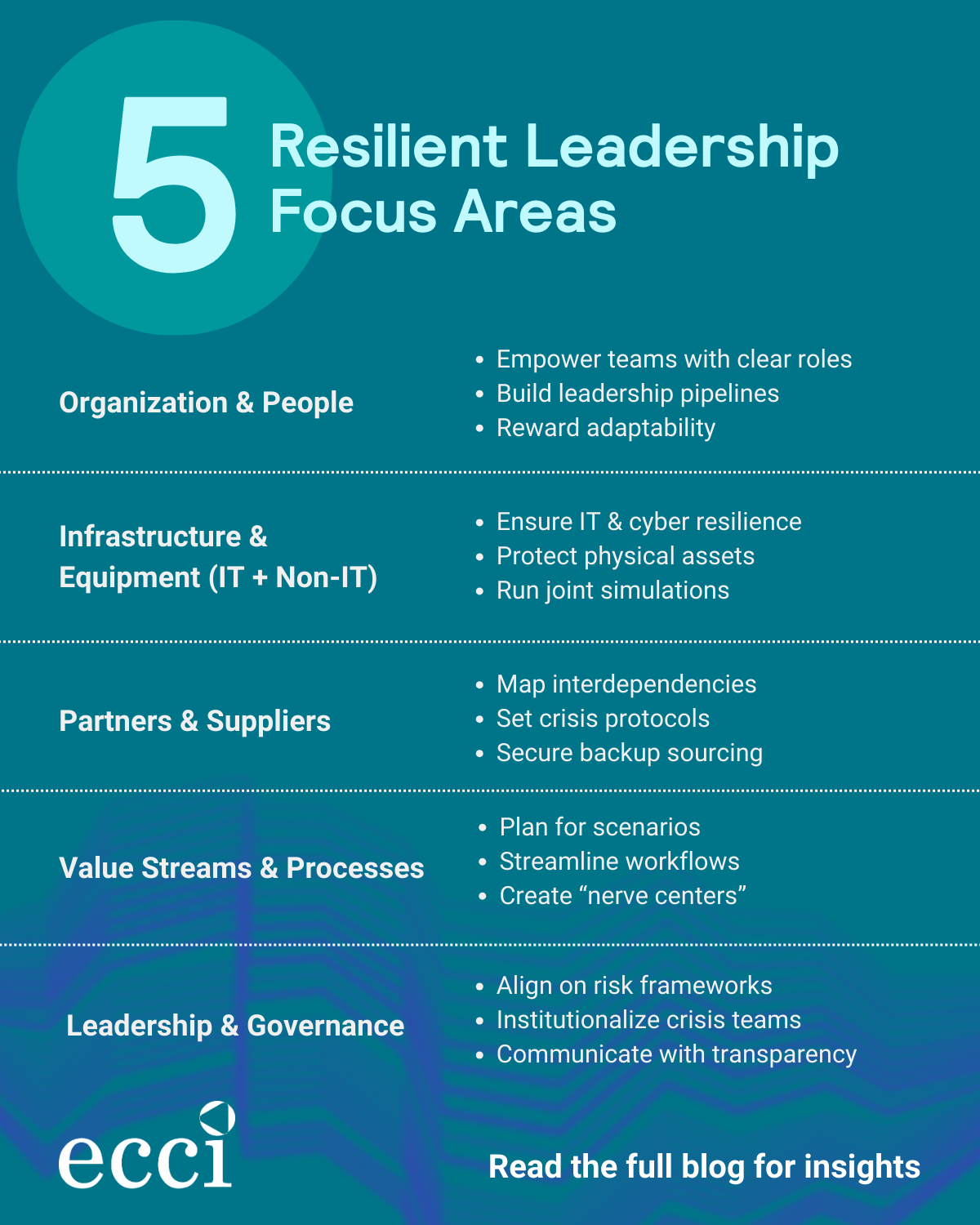
Five Focus Areas for Resilient Leadership
Resilience must be built intentionally across five critical areas:
1. Organization & People
Disruptions place enormous strain on people and leadership structures. Resilient organizations:
- Empower teams with decision rights and crisis playbooks.
- Strengthen leadership pipelines through training in systems thinking and ambiguity tolerance.
- Redefine incentives to reward adaptability and collaboration.
👉 Takeaway for leaders: Invest in people capability. Crisis readiness is not just about plans—it’s about empowering teams to act decisively under pressure.
2. Infrastructure & Equipment (IT and Non-IT)
Both technology and physical assets are essential for continuity. Leaders must:
- Ensure IT resilience through cybersecurity readiness, cloud recovery, and redundancy.
- Safeguard physical infrastructure with preventive maintenance and contingency planning.
- Run joint simulations to test IT and non-IT systems together.
👉 Takeaway for leaders: Don’t treat IT and physical assets in silos—test them together. True resilience comes when digital and physical infrastructure can withstand shocks simultaneously.
3. Partners & Suppliers
Global supply chain fragility makes external dependencies a critical risk area. Resilient enterprises:
- Map supplier and partner interdependencies.
- Establish crisis communication protocols with third parties.
- Build contingency sourcing and backup supplier strategies.
👉 Takeaway for leaders: Strengthen external trust as much as internal capacity. In a crisis, supplier and partner response time can determine your recovery speed.
4. Value Streams & Processes
Core processes must continue—even under disruption. Leading organizations:
- Integrate scenario planning into operational reviews.
- Streamline workflows so teams can pivot quickly.
- Create cross-functional “nerve centers” for unified response.
👉 Takeaway for leaders: Simplify before you scale. Leaner, more flexible processes recover faster when disruption hits.
5. Leadership, Crisis Management & Governance
At the center of resilience is leadership. Enterprises that succeed:
- Align leaders around shared risk frameworks.
- Institutionalize crisis management structures and risk councils.
- Conduct simulations, after-action reviews, and transparent crisis communications.
👉 Takeaway for leaders: Model resilience from the top. Leadership alignment and visible accountability build confidence inside and outside the organization.
From Concept to Capability: Institutionalizing Resilience
To translate these focus areas into action, organizations must:
- Test readiness by assessing decision rights, planning cycles, and collaboration.
- Build leadership pipelines prepared for ambiguity and cross-functional crisis response.
- Embed resilience into governance through metrics, dashboards, and risk councils.
The Path Forward
In an era of compounding disruption, the most successful enterprises are measured not only by their efficiency but by their adaptability. By strengthening resilience across people, infrastructure, partners, processes, and governance, leaders can ensure that crisis management, crisis communications, and crisis response are no longer reactive measures, but embedded capabilities.
How We Can Help
At ECC International, we help organizations institutionalize resilience through a structured Business Continuity Management System (BCMS) aligned with ISO 22301 and global best practices. From business impact analysis and risk assessments to designing crisis response plans and running simulations, we support the full BCMS lifecycle.
Beyond compliance, we focus on building leadership capability and integrating continuity principles with enterprise risk, ESG, and transformation priorities. For companies pursuing ISO 22301 certification, we ensure alignment between governance structures and operational realities.
To learn more, visit eccinternational.com/consulting/business-continuity-management-system