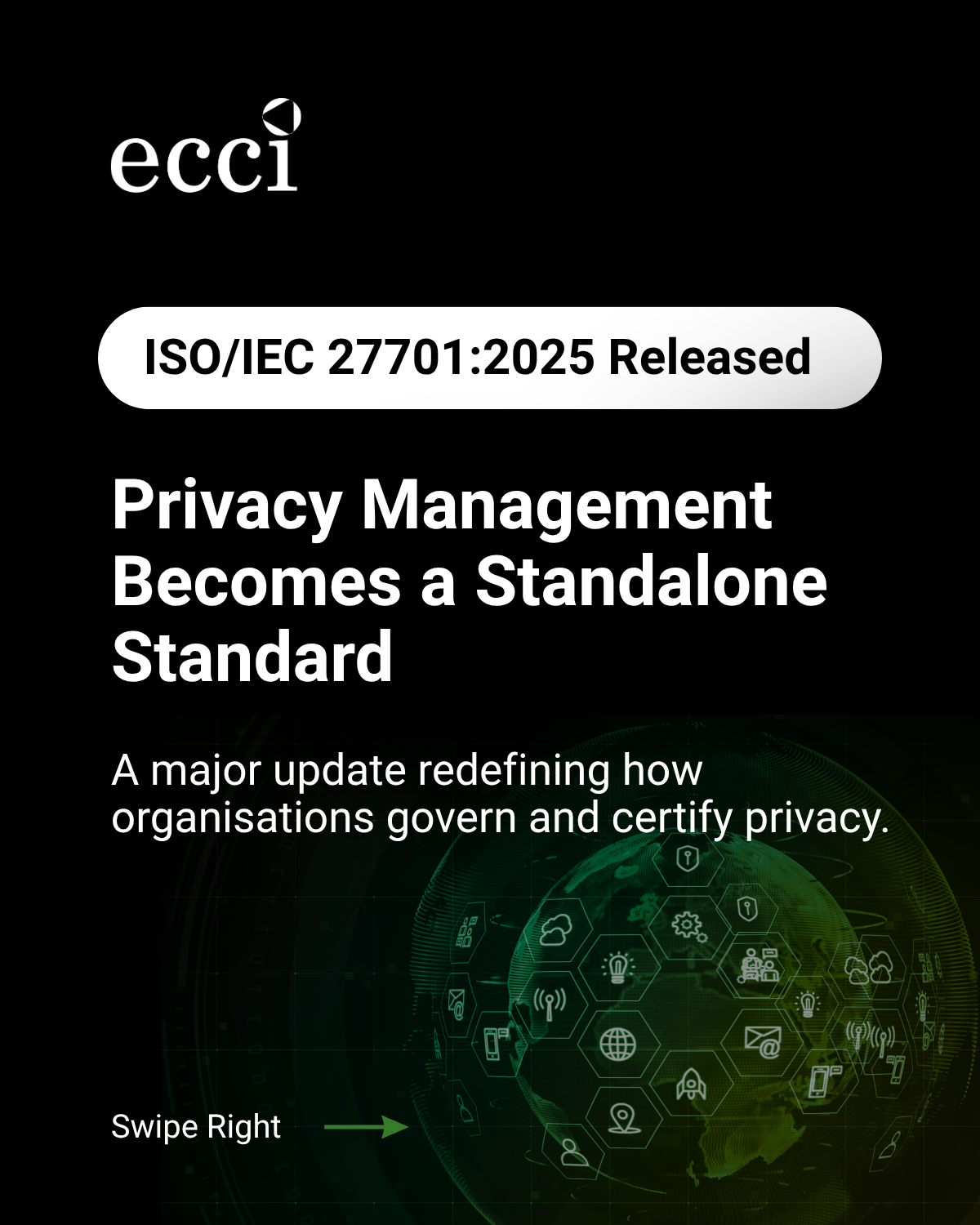
A major update redefining how organizations certify privacy governance
On October 14, 2025, the International Organization for Standardization (ISO) and the International Electrotechnical Commission (IEC) released the new edition of ISO/IEC 27701 — a landmark update that redefines privacy governance worldwide.
The ISO/IEC 27701:2025 standard introduces a pivotal change: organisations can now implement and certify a Privacy Information Management System (PIMS) independently of ISO/IEC 27001. This shift marks the first time privacy management stands as a discipline of its own, no longer requiring prior certification in information security management.
For businesses, regulators, and consulting professionals, this development reflects how deeply privacy has evolved — from a compliance add-on to a strategic governance priority.
Why This Update Matters
Since its first publication in 2019, ISO/IEC 27701 functioned as an extension of ISO/IEC 27001 — a privacy layer built atop an information security foundation. But today’s business environment is vastly different. AI models, cloud ecosystems, cross-border data flows, and rapidly shifting regulations demand a more autonomous, adaptive, and accountable privacy framework.
ISO/IEC 27701:2025 delivers exactly that, bringing privacy to the boardroom and embedding it into enterprise governance and risk strategy.
Key Updates at a Glance
| Area | 2019 Edition | 2025 Edition (New) | Implication |
| Certification Basis | Dependent on ISO/IEC 27001 certification | Now standalone — no prerequisite ISMS required | Expands accessibility to organisations without ISO 27001 |
| Framework Structure | Add-on clauses aligned to ISO 27001:2013 | Now follows ISO’s High-Level Structure (HLS) (Clauses 4–10) | Easier integration with other ISO systems (e.g., ISO 9001, ISO/IEC 42001) |
| Control Framework (Annex A) | Separate controls for Controllers and Processors | Reorganised & consolidated — clearer roles, privacy-specific controls | Simplified implementation and governance |
| Scope of Controls | Focused on traditional data security | Expanded to include AI, cloud, cross-border processing, consent, automated decisions | Reflects evolving privacy landscape |
| Leadership & Governance | Limited top-management involvement | Explicit accountability for leadership, roles, resources, and culture | Positions privacy as an enterprise-wide function |
| Transition for Existing Certificates | Not applicable | Transition required within 2–3 years (subject to certification-body timelines) | Early alignment recommended for 2026–2027 audits |
What This Means for Organisations
This revision sends a clear message: privacy is governance.
The 2025 edition embeds privacy risk into organisational planning, performance evaluation, and continual improvement — the same rigor once reserved for quality or security systems.
For enterprises in the Philippines and across ASEAN, the timing could not be more relevant:
- The Philippine Data Privacy Act of 2012 continues to mature in enforcement.
- Investors and regulators now expect privacy disclosures in ESG and corporate sustainability reporting.
- Digital-first business models require trusted data ecosystems that go beyond compliance.
In this context, ISO/IEC 27701:2025 becomes both a strategic enabler and a competitive differentiator — a way to demonstrate that privacy is not only protected but governed, measured, and continually improved.
Next Steps for Organisations
- Elevate Awareness and Ownership
Educate executives on how ISO/IEC 27701:2025 reframes privacy as leadership accountability, not just IT control. - Conduct a Privacy Gap Assessment
Benchmark existing privacy policies, PII inventories, and data-protection programs against the 2025 clauses and updated controls. - Decide Integration Path
Choose whether to build a standalone PIMS or integrate it with existing ISMS, quality, or risk frameworks. - Redefine Controls and Documentation
Update governance policies, risk registers, and operational procedures to align with the restructured Annex A. - Prepare for Certification Transition
Engage early with certification bodies to plan migration timelines from the 2019 to the 2025 edition.
The Strategic Lens: Why Early Adoption Matters
Early adopters will gain more than compliance readiness, they’ll build institutional trust capital.
By aligning privacy governance with enterprise risk, ESG disclosure, and digital resilience strategies, organisations signal to stakeholders that they manage data ethically, securely, and sustainably.
In the coming years, ISO/IEC 27701:2025 certification will likely serve as a global trust mark, much like ISO 9001 for quality and ISO/IEC 27001 for security.
How ECCI Helps
At ECCI, we help organisations move from compliance to leadership in data privacy and governance by conducting PIMS readiness and gap assessments aligned with ISO/IEC 27701:2025, designing transition and integration roadmaps for companies with existing ISO 27001 systems, and embedding privacy governance into broader ESG, sustainability, and enterprise-risk frameworks. We enable organisations to build a privacy-mature, audit-ready, and future-proof governance system — one that goes beyond compliance to create lasting business trust.