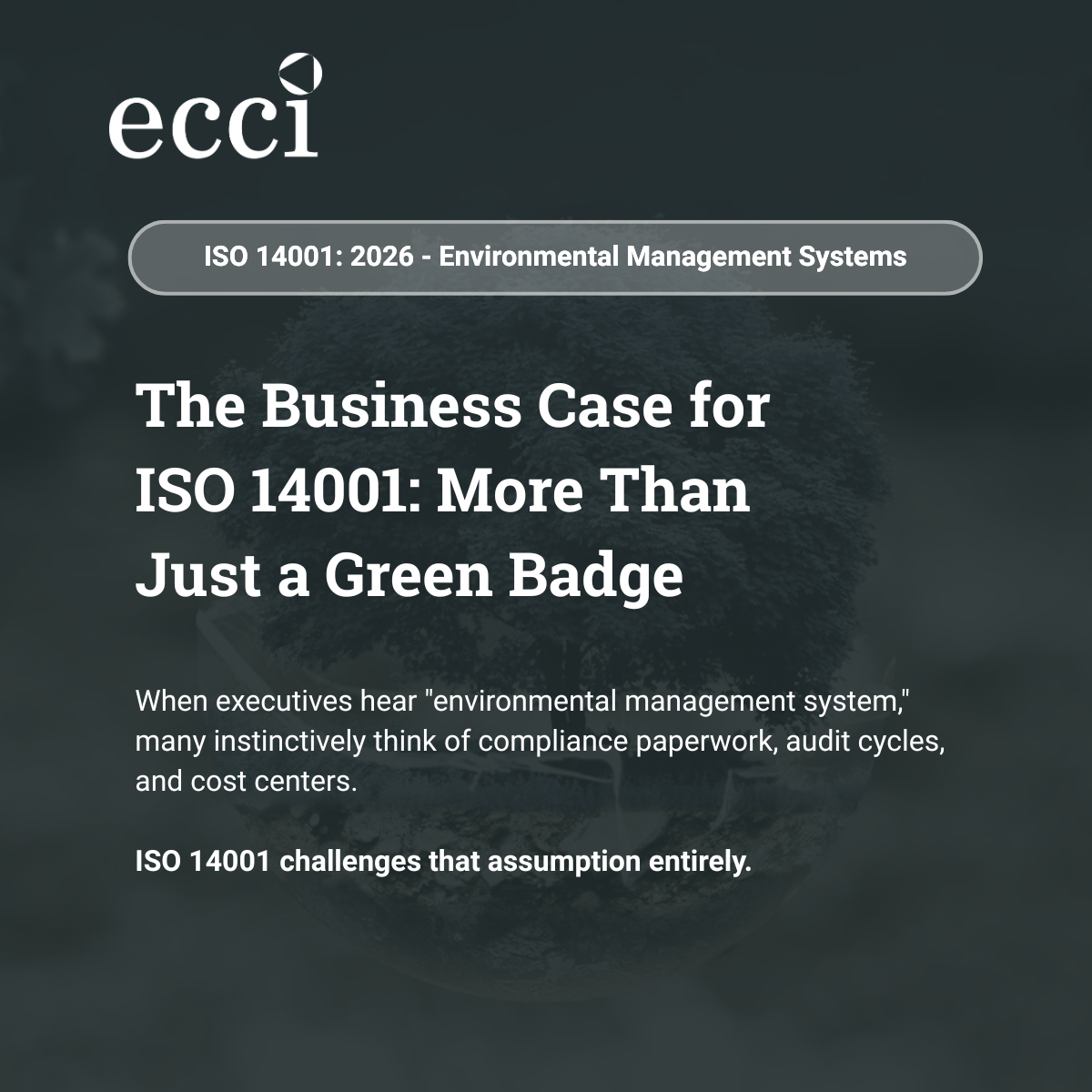
When executives hear “environmental management system,” many instinctively think of compliance paperwork, audit cycles, and cost centers. ISO 14001 challenges that assumption entirely. For organizations willing to look beyond the certificate on the wall, the standard is one of the most underutilized tools for driving measurable business value — from the boardroom to the factory floor.
The Real ROI of Environmental Discipline
At its core, ISO 14001 is a framework for understanding and systematically reducing your organization’s environmental footprint, ensuring compliance with environmental regulations, managing environmental risks, and improving environmental performance over time. It is worth noting that operational improvements that follow tend to benefit the bottom line just as much as the planet.
Energy and resource efficiency is where the gains are most immediate. The standard’s requirement to identify significant environmental aspects, such as energy consumption, water usage, and material waste, forces organizations to measure what was previously untracked. And what gets measured gets managed. Companies that have implemented ISO 14001 consistently report reductions in utility costs, raw material waste, and disposal expenses. These aren’t incidental savings; they are the direct result of a structured, repeatable management process.
Waste reduction is another tangible area of impact. ISO 14001 pushes organizations to evaluate the full lifecycle of their operations — from procurement through production to disposal. The result is often a leaner, more efficient operation where waste is treated not as an inevitable byproduct, but as a design problem to be solved.
Incident prevention also carries significant financial weight. Incidents such as spills, breaches, and non-compliant discharges generate cleanup costs, regulatory penalties, and reputational damage that can far exceed the investment in proactive management. ISO 14001’s emergency preparedness requirements build the internal controls that reduce this risk exposure.
Supply Chain and Procurement Leverage
For organizations operating in global supply chains, ISO 14001 certification is increasingly an Environmental prerequisite rather than a differentiator. Major multinationals across manufacturing, retail, and financial services are extending environmental requirements to their suppliers. Holding ISO 14001 certification signals operational credibility and opens doors to procurement relationships that might otherwise be out of reach.
Conversely, organizations that have achieved certification can use the standard as a lens for evaluating their own suppliers, building a more resilient and responsible supply chain from the ground up.
A Note on the Broader Reporting Landscape
It is worth noting that ISO 14001’s structured approach to environmental data collection and management aligns naturally with the emerging expectations of global sustainability disclosure frameworks. The ISSB’s IFRS S2 standard on climate-related disclosures, for instance, requires companies to demonstrate how they manage environmental risks. This is precisely the kind of internal discipline that ISO 14001 builds.
In other words, the operational foundation you establish through ISO 14001 becomes an asset when fulfilling investor-facing reporting obligations.
Efficiency is a Strategy, and ECCI Helps You Execute It
The business case for ISO 14001 is straightforward: organizations that understand, measure, and improve their environmental performance are more efficient, better prepared for disruption, and better positioned to meet the expectations of customers, investors, and partners.
This is where ECCI’s ESG services make the difference. ECCI works alongside C-suite leaders to build the systems and governance frameworks that turn environmental management into measurable competitive advantage, embedding ISO 14001 not as a compliance exercise, but as an engine for operational excellence.
The value is clear. The question is whether you have the right partner to capture it.