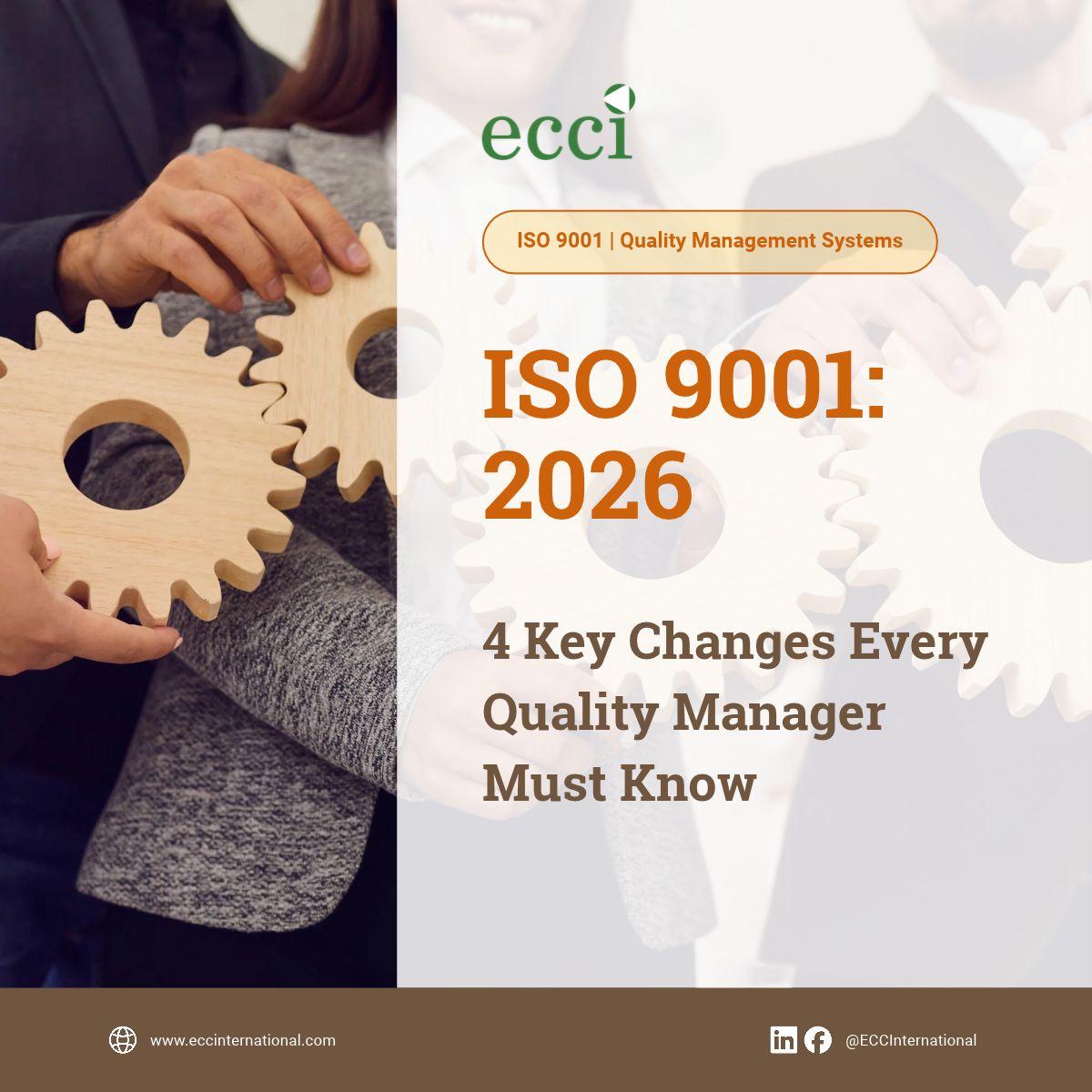
The ISO 9001:2026 changes are finally here.
The good news is that they refine the world’s leading Quality Management System (QMS) standard rather than reinvent it. On September 16, 2026, the International Organization for Standardization (ISO) published ISO 9001:2026, and more than one million certified organizations now need to know what’s different.
If you manage quality, compliance, or operations, this guide breaks down the four changes that matter most. First, though, here’s the reassuring headline: this is evolution, not revolution. Your existing system is the foundation, not the casualty.
The 4 Key ISO 9001:2026 Changes You Need to Know
The high-level framework stays intact, but four targeted updates modernize the standard. Here’s what each one means for your day-to-day quality management.
1. Climate Change Is Now Part of Your Context (Clause 4.1)
First, the 2026 edition folds the 2024 climate action amendment directly into Clause 4.1. As a result, you must now assess whether climate change is a relevant issue for your organization’s context.
You must also document that decision.
In practice, this simply formalizes a step many quality teams already take, so most organizations will find it a light lift.
2. Quality Culture and Ethical Behavior Take Center Stage (Clauses 5.1.1 & 7.3)
Second, Clause 5.1.1 now asks top management to actively promote and visibly demonstrate a quality culture and ethical behavior. Clause 7.3 extends that expectation to every employee, so your workforce understands how ethical conduct supports quality outcomes.
Therefore, both leadership evidence and awareness training carry more weight than they did in 2015.
3. Risk and Opportunity Get Separate Workflows (Clause 6.1)
Third, Clause 6.1 splits into distinct subclauses (6.1.1–6.1.3). This restructure draws a clearer line between mitigating risks and pursuing strategic opportunities. Because the two now sit apart, your risk register and procedures should treat them as separate workflows rather than one blended list.
4. Expanded Guidance Makes the Standard Easier to Apply (Annex A & Clause 3)
Finally, Annex A delivers significantly expanded, clause-by-clause guidance, while Clause 3 brings key QMS terms directly into the standard. In short, the 2026 edition is easier to interpret and apply, especially for teams pursuing certification for the first time.
What Stays the Same in ISO 9001:2026
Just as important as the changes is what carries forward unchanged. If you’re certified to ISO 9001:2015, your core architecture holds:
- The harmonized structure. The standard keeps the 10-clause Annex SL framework (Clauses 4–10), so it still aligns cleanly with ISO 14001 (Environmental) and ISO 45001 (Occupational Health & Safety).
- The core principles. The process approach, customer focus, performance evaluation, and continual improvement all remain in place.
- Your existing investment. Every process and document you built for 2015 becomes the direct baseline for 2026—nothing is wasted.
Your 3-Year Transition Roadmap
Publication opens a standard three-year transition window, so you can update your system at a controlled pace:
- Transition deadline: ISO 9001:2015 certificates stay fully valid through September 2029.
- Audit availability: Certification bodies usually need 9–12 months to secure national accreditation, so expect the first accredited 2026 audits around mid-to-late 2027.
- No reason to delay: If you’re not yet certified, start with ISO 9001:2015 now. Every bit of foundational work transfers straight to 2026.
Action Checklist for Quality Managers
Ready to get ahead of the transition? Start here:
- Verify your context analysis. Confirm your Clause 4.1 review captures environmental and climate considerations.
- Gather leadership evidence. Document how executives actively promote ethical conduct and quality values.
- Separate risk and opportunity. Make sure your risk register distinguishes controls from strategic opportunities.
- Schedule a gap review. Benchmark your current system against the 2026 requirements before your next surveillance cycle.
How to Prepare for the Transition
Because a smooth transition keeps operational friction low, focused support usually spans four areas:
- Executive briefings on the new leadership expectations
- A gap analysis against the 2026 clauses
- A restructure of your risk-and-opportunity workflows
- A refreshed workforce training ahead of recertification.
ECCI offers gap assessments, leadership workshops, training programs, and implementation support tailored to your specific needs. Contact our quality management specialists to discuss how we can help you navigate this transition smoothly and strategically.
You can also read our Practical Transition Action Plan for ISO 9001:2026 here for an in-depth, step-by-step roadmap to guide your organization through every stage of the transition.