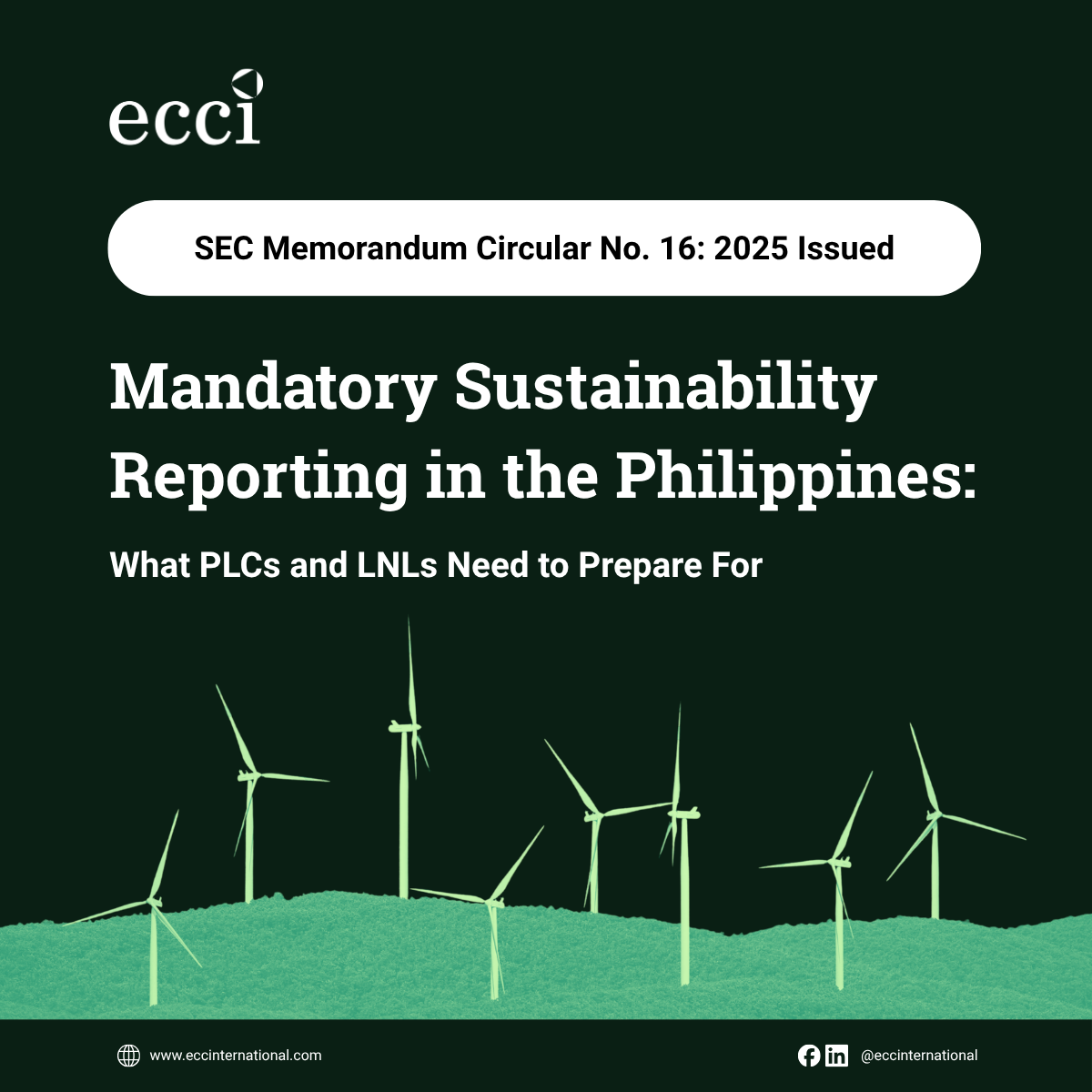
On December 22, 2025, the Securities and Exchange Commission (SEC) issued the guidelines for Memorandum Circular No. 16, series of 2025, formally adopting the Philippine Financial Reporting Standards (PFRS) S1 and S2. These standards align with the International Sustainability Standards Board (ISSB) global framework for sustainability disclosures.
With this adoption, sustainability reporting is no longer a supplementary narrative. It is now embedded within financial reporting expectations — subject to the same scrutiny, governance, and assurance standards.
A Structural Shift in Reporting Philosophy
SEC MC 4 (2019) aligned with frameworks such as the Global Reporting Initiative (GRI, a stakeholder-focused ESG standard), Sustainability Accounting Standards Board (SASB), Integrated Reporting <IR>, and Task Force on Climate-related Financial Disclosures (TCFD). The emphasis was on stakeholder-oriented disclosures and broader environmental and social impact. Under PFRS S1 and S2, the emphasis is more precise and financially oriented.
| Old (MC 4) | New (MC 16) |
| Narrative Style Reporting Descriptive ESG storytelling; no link to financial statements. | Sustainability-related Financial Disclosures Sustainability risks are connected directly to cash flows, access to finance, and cost of capital. |
| Comply or Explain Companies could skip disclosures by explaining why data was unavailable. | Mandatory Compliance Transition reliefs replace ‘explain’. Non-attachment of the SR is treated as an Incomplete Annual Report under SEC MC 6 (2005), with a separate penalty scale for non- or late submission. No opt-out provision. Penalty count starts fresh under MC 16. |
| No Mandatory Assurance External assurance was voluntary. | Assurance Trajectory Limited assurance on Scope 1 & 2 (ISSA 5000) mandatory 2 years post-adoption. Progresses to reasonable assurance. |
The core question has shifted from “How does the organization impact the environment and society?” to “How do sustainability-related risks and opportunities affect financial performance, position, and future cash flows?”
This distinction raises the evidentiary threshold. The result is a more integrated and decision-useful form of reporting, particularly for investors, lenders, and regulators.
Relevance in the Philippine Market
The Philippines sits at the epicenter of physical climate risk, with an average of 20 typhoons annually entering the Philippine Area of Responsibility (PAR). This has direct implications for asset resilience, operational continuity, and long-term capital planning.
Sustainability disclosures are increasingly read as indicators of risk management maturity, operational resilience, and financial preparedness under varying climate scenarios. As capital markets integrate climate considerations into investment decisions, better disclosures improve your access to financing and reduce your cost of capital.
Phased Implementation, Exemptions, and Reliefs
Tier classifications were fixed as of December 31, 2025 and will not change regardless of future market capitalization fluctuations.
- Tier 1 PLCs (market cap > ₱50B): adopt PFRS S1 and S2 for FY 2026
- Tier 2 PLCs (market cap ₱3B–₱50B): adopt for FY 2027
- Tier 3 firms (PLCs with market cap ≤₱3B, or LNLs with revenue > ₱15B): adopt for FY 2028
LNL Exemptions
For large non-listed (LNL) companies, the ₱15B revenue threshold is re-evaluated each fiscal year ending on or after December 31, 2027. Exemption is available, but only if all three conditions are met simultaneously:
- The parent company files a Sustainability Report under PFRS/IFRS S1 & S2, European Sustainability Reporting Standards (ESRS), or an equivalent home jurisdiction standard aligned with global frameworks.
- The LNL’s specific disclosures are explicitly included in the parent’s consolidated report. Cross-referencing without data integration is insufficient.
- A Certificate of Exemption (Annex A), signed by both the Corporate Secretary/CSO and the Chairman of the Board, is submitted.
If any one condition is unmet, the exemption is void and the LNL must file a full, independent Sustainability Report. This exemption is not automatic and resets each year.
Reliefs
Following the phased tier implementation, the SEC has provided some reliefs for the PFRS S1 and S2 sustainability reporting transition:
| Relief | Description | Tier 1 | Tier 2 | Tier 3 |
| Climate-First Approach | Disclose only PFRS S2 (Climate). | Only applicable for Year 1 (FY 2026) | Only applicable for Year 1 (FY 2026) | Applicable for Years 1 and 2 (FY 2026 – 2027) |
| Delayed Reporting | File sustainability report within 9 months of the FY-end (instead of with Annual Report). | Only applicable for Year 1 (FY 2026) | Only applicable for Year 1 (FY 2026) | Only applicable for Year 1 (FY 2026) |
| No Comparative Data | First report is standalone; no requirement to present previous year’s data for comparison. | Only applicable for Year 1 (FY 2026) | Only applicable for Year 1 (FY 2026) | Only applicable for Year 1 (FY 2026) |
| Alternative GHG Methodology | Use non-GHG Protocol methodology if previously applied. | Only applicable for Year 1 (FY 2026) | Only applicable for Year 1 (FY 2026) | Only applicable for Year 1 (FY 2026) |
| No Scope 3 | Disclosure of Scope 3 GHG emissions is not mandatory for the first two years | Applicable for Years 1 and 2 (FY 2026 – 2027) | Applicable for Years 1 and 2 (FY 2026 – 2027) | Applicable for Years 1 and 2 (FY 2026 – 2027) |
The PFRS Framework — S1 and S2 Explained
PFRS S1
PFRS S1 requires material information about all sustainability-related risks and opportunities connected to a company’s financial statements. It applies across every sector and every sustainability topic.
PFRS S1 establishes:
- The Four Core Pillars framework:
- Governance – How the Board oversees sustainability
- Strategy – How risks affect the business model
- Risk Management – How risks are identified and managed
- Metrics & Targets – Determining which data proves progress
- Financial materiality guidance
- Reporting entity boundaries
- Qualitative characteristics of disclosures
PFRS S1 reframes sustainability reporting around one question: does this risk affect financial value? This differs from the GRI/double materiality approach, which asks how the company affects the world. The comparison below shows the key distinctions:
| Dimension | GRI / Double Materiality | PFRS S1 / Financial Materiality |
| Core question | How does the company affect society and the environment? | How do sustainability risks affect the company’s financial value? |
| Materiality test | What matters to stakeholders — NGOs, employees, communities | What could affect cash flows, cost of capital, or access to finance |
| Evidence standard | Narrative, qualitative, stakeholder-driven | Quantified, auditable, financially traceable |
| Output | Standalone sustainability report | Integrated with financial statements; board-approved; subject to assurance |
By anchoring disclosures to cash flows and cost of capital rather than to stakeholder perception, PFRS S1 demands the same evidentiary rigour as financial statements themselves.
PFRS S2
S2 is the climate-specific standard, built directly on the TCFD architecture. It requires disclosure of both physical and transition climate risks and opportunities. To put it simply, PFRS S2 is TCFD made mandatory.
It requires:
- Scenario analysis using recognized climate pathways (RCP/SSP — see below)
- Scope 1 and Scope 2 GHG emissions (Scope 3 has a two-year relief)
- Quantified, traceable financial impact pathways
- Transition planning linked to financial statements
A Climate Risk Assessment identifies which company assets face exposure, assigns vulnerability scores, and runs scenario projections to produce the quantified financial ranges PFRS S2 requires. Companies do not need to treat a CRA as an annual exercise; reviewing it every three to five years is enough, or whenever major triggers arise, such as mergers, significant asset expansion, or new regulations.
Climate Scenario Analysis tests how a company would fare under different possible climate futures. It is based on two scientific frameworks:
| Representative Concentration Pathways (RCP) | Shared Socio-economic Pathways (SSP) | |
| Description | A framework for modelling future GHG concentrations in the atmosphere. It answers the question: how hot could it get? | The evolution of RCPs — combining physical climate outcomes with the societal choices that drive them. It answers the question: what kind of world produces the level of warming? |
| Era | Introduced in IPCC AR5 (2013) | Introduced in IPCC AR6 (2021) |
| Focus | Physical outcomes only — warming levels | Physical outcomes + societal context |
| Human Choices? | No — only models the climate result | Yes — models the world that creates it |
| Good For | Understanding possible temperature ranges | Guiding real-world policy and planning |
SSPs have replaced RCPs as the IPCC standard since AR6 (2021), but companies may still use both.
PFRS S2 gives investors clear, evidence-based insight into how climate change exposes a company’s financial position — not just as a narrative, but as a decision-making tool.
Why This Shift is Bigger Than Compliance
Companies that treat PFRS S1 & S2 compliance as a strategic exercise will gain a measurable advantage. Three reasons stand out:
- Climate risk here is not theoretical. The Philippines ranks first in the World Risk Index for climate exposure. With 20 typhoons annually, climate risk directly affects assets, supply chains, and insurance premiums.
- PFRS S1 & S2 alignment is the gateway to global capital. As international investors decarbonize portfolios, Philippine companies must demonstrate resilience to remain bankable.
- The disclosure is not the hard part. Data governance, risk assessment, and strategic integration drive the real work — and teams must complete all of it months before anyone writes the report.
This is where ECCI can help.
With over 25 years of consulting experience, ECCI helps organizations build credible, audit-ready sustainability disclosures aligned with PFRS S1 and S2. We guide companies through readiness assessments, GHG inventory development and validation, ESG governance and reporting framework design, and external assurance preparation under ISSA 5000.
Our work goes beyond compliance; we empower businesses to embed sustainability into their core strategy for long-term growth and resilience.