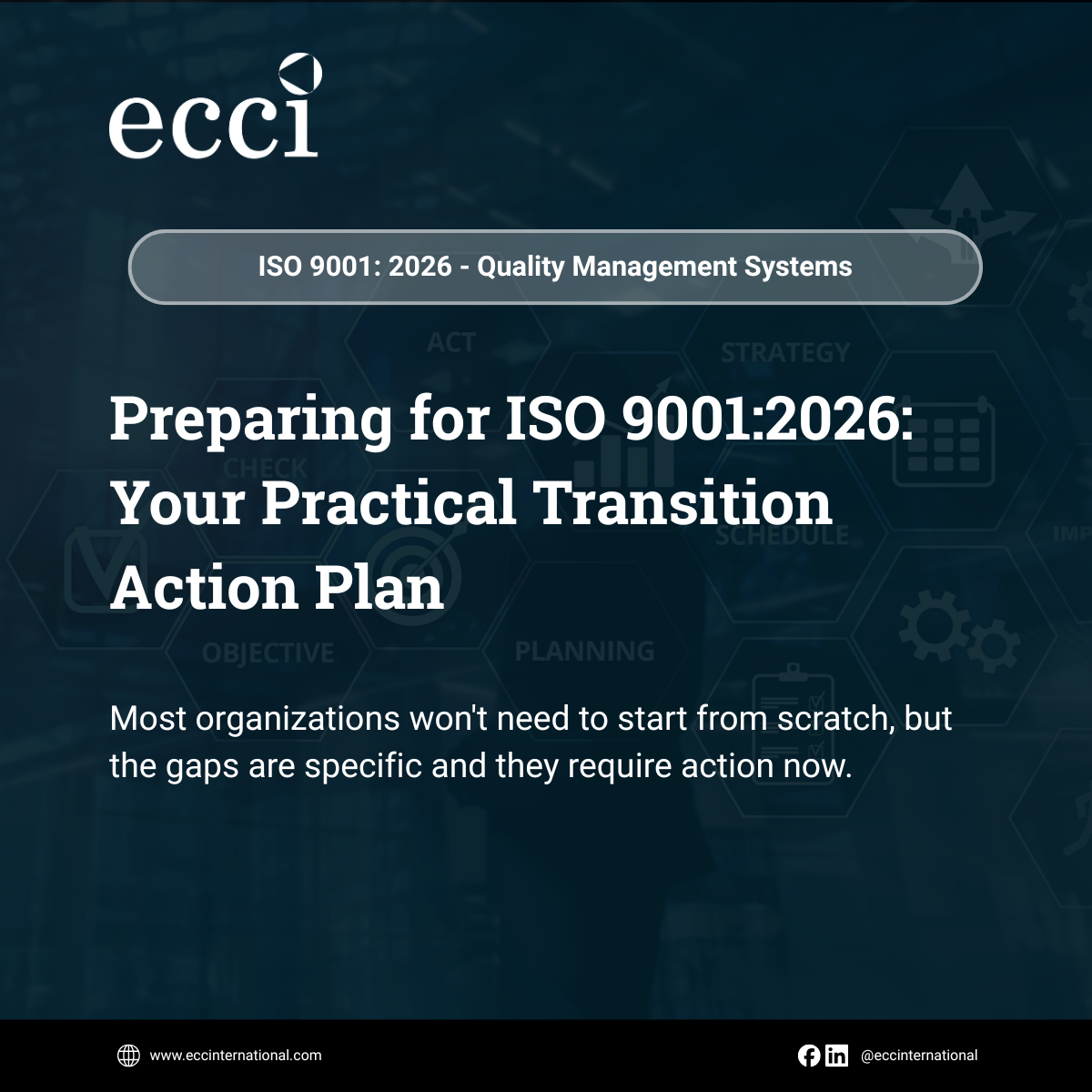
ISO 9001:2026 publication is anticipated in September 2026, and your ISO 9001:2026 transition plan should start today, not at the deadline. Organizations with a clear action plan will find the shift smooth and even beneficial; those that wait will scramble. This guide walks you through seven practical steps to close the gaps, secure leadership buy-in, and position your QMS for a confident transition.
Step 1: Conduct a Focused Analysis
Start by understanding where you stand. Focus on the four key areas where ISO 9001:2026 brings significant changes:
Leadership Commitment to Culture & Ethics
- Is quality culture explicitly part of leadership responsibilities?
- Can you show evidence of leadership actively promoting quality culture beyond approving policies?
- Are ethical behavior expectations documented in your quality context?
- How visible is leadership in quality improvement initiatives?
If leadership treats quality as the quality department’s domain rather than organizational value, you have a gap.
Climate Change Context Assessment
- Have you assessed climate-related risks to operations, supply chain, or market?
- Are climate regulations or stakeholder expectations relevant to your industry?
- Is this assessment documented in your context analysis?
Even if climate seems minimally relevant, the assessment and rationale must be documented.
Risk vs. Opportunity Separation
- Are opportunities given sufficient visibility alongside risk management activities?
- Do you have explicit processes for identifying opportunities proactively?
- Can you demonstrate opportunity-seeking linked to strategic objectives?
- Is your resilience planning approach clearly structured?
If opportunities are only addressed reactively or secondary to risk management, this needs restructuring.
Awareness Programs Coverage
- Do training programs cover values and culture, not just technical procedures?
- Are quality, culture, and ethical behavior explicitly included?
- Can employees articulate how their work contributes to quality outcomes?
Step 2: Secure Leadership Buy-In
Success depends on leadership engagement—not just project approval, but understanding their expanded role.
Educate Top Management
Present a concise briefing covering:
- Timeline and organizational implications
- Four key change areas and their specific leadership responsibilities
- What quality culture and ethical behavior mean concretely
Define Quality Culture for Your Organization
Work with leadership to define:
- What quality culture looks like in your daily operations
- Behaviors demonstrating commitment to quality
- Integration with other organizational values
- How you’ll measure culture beyond compliance metrics
Establish Ethical Behavior Expectations
Clarify what ethical behavior means in your quality context:
- Decision-making principles when quality and other pressures conflict
- How ethical concerns are raised and addressed
- Integrity expectations in reporting and stakeholder interactions
Create Visible Leadership Commitment
Plan tangible demonstrations:
- Regular quality-focused communications from top management
- Leadership participation in quality reviews and improvements
- Quality culture as standing management meeting agenda item
Step 3: Enhance Organizational Context Analysis
Your context analysis needs explicit climate consideration while remaining comprehensive.
Conduct Climate Relevance Assessment
Structure your assessment around:
Physical considerations:
- Facility vulnerability to climate events (flooding, extreme heat, storms)
- Climate effects on raw material availability or cost
- Supply chain reliability impacts
Market and regulatory considerations:
- Current or emerging regulations on emissions, energy, sustainability
- Customer or stakeholder sustainability requirements
- Climate consciousness affecting market demand
Operational considerations:
- Significant energy consumption or emissions
- Climate trends affecting business model viability
- Opportunities in climate solutions or sustainable alternatives
Document findings and conclusions about climate relevance, even if minimal.
Update Context Documentation
Ensure your context analysis:
- Explicitly considers climate change among relevant external issues, where applicable
- Connects climate considerations to stakeholder expectations
- Identifies quality implications from climate-related risks or opportunities
- Receives top management review and approval
Step 4: Restructure Risk & Opportunity Management
Create distinct but parallel processes:
| For Risk Management: | For Opportunity Management: |
| Identify what could prevent achieving QMS and conformity objectives | Proactively identify opportunities for improvement, growth, innovation |
| Assess and prioritize risks | Evaluate opportunities against strategic direction |
| Plan and implement risk treatments | Plan and implement opportunity pursuit |
| Monitor control effectiveness | Monitor opportunity realization |
Link Opportunities to Strategic Direction
Connect opportunity identification to:
- Quality policy and strategic objectives
- Customer needs including emerging requirements
- Technological advances and market trends
- Process improvement potential
Document the New Structure
Update Clause 6.1 documentation showing:
- How risks are identified, assessed, and addressed
- How opportunities are identified, evaluated, and pursued (clearly defined approach)
- Links to strategic planning
- Evidence of balance between defensive and proactive approaches
Step 5: Expand Awareness Programs
Training must evolve from compliance-focused to culture-building.
Redesign Training Content
| Quality Culture Module | Ethical Behavior Module | Strategic Awareness Module |
| What quality means beyond conformity | Ethical expectations in quality contexts | Quality policy connection to business strategy |
| How culture manifests in daily work | How to raise quality or ethical concerns | How QMS supports organizational objectives |
| Real examples from your organization | Decision-making frameworks for quality dilemmas | External context relevance (including climate where applicable) |
| How roles contribute to organizational quality |
Make It Relevant
- Use real organizational examples
- Create role-specific scenarios
- Include leadership participation
- Make it interactive, not just presentations
Extend Beyond Initial Training
- Regular communications reinforcing messages
- Recognition of behaviors exemplifying quality values
- Integration into performance management
- Refresher training and updates
Step 6: Plan Your Transition Timeline
Recommended Timeline:
| Now – September 2026 (Pre-Publication) | September 2026 – March 2027 (Early Implementation) | April 2027 – August 2027 (Full Implementation) | August 2027 – March 2028 (Transition Audit) |
| 1. Complete gap analysis | 1. Finalize gap analysis against published standard | 1. Complete all documentation updates | 1. Schedule transition audit with certification body |
| 2. Secure leadership buy-in | 2. Update documentation (context analysis, procedures) | 2. Conduct internal audits against ISO 9001:2026 | 2. Provide conformity evidence |
| 3. Define quality culture and ethical behavior | 3. Restructure Clause 6.1 processes | 3. Build track record of new processes | 3. Address audit findings |
| 4. Begin climate context assessment | 4. Launch updated training programs | 4. Address internal audit findings | 4. Obtain ISO 9001:2026 certification |
Why Start Early?
- Spread effort over time vs. crisis pressure
- Integrate changes naturally into existing improvement cycles
- Avoid the rush as 2029 deadline approaches
- Potentially gain competitive advantage with early certification
Step 7: Leverage for Actual Improvement
Don’t treat this as just certification maintenance—use it to strengthen your QMS.
Build Engagement Through Culture Focus
- Have meaningful conversations about how your organization approaches quality
- Identify and address cultural barriers to quality performance
- Build ownership beyond the quality department
- Connect quality to organizational pride
Future-Proof Through Climate Context
- Reveal emerging risks you hadn’t considered
- Identify opportunities in sustainable markets
- Build operational resilience
- Align with growing stakeholder expectations
Drive Innovation Through Opportunity Focus
- Encourage proactive thinking beyond problem-solving
- Connect quality management to business development
- Foster innovation in processes, products, services
- Build strategic agility
Elevate Quality’s Role Through Leadership Expectations
- Make quality a management agenda item
- Secure direct leadership engagement
- Obtain resources for culture-building
- Integrate quality into strategic decisions
Document as You Go
Maintain clear documentation throughout:
- Gap analysis findings and closure plans
- Leadership decisions about culture and ethics definitions
- Climate context assessment process and conclusions
- Updated context analysis and restructured risk/opportunity processes
- Evidence of leadership commitment
- Training materials and effectiveness measures
- Internal audit results
- Management review discussions
Common Pitfalls to Avoid
Over-complicating Changes. The revisions are targeted, not comprehensive. Enhance specific areas—don’t rebuild your entire QMS.
Treating Culture as Documentation. Culture requires genuine leadership commitment and behavioral change, not just policies. Focus on actions.
Ignoring Climate Assessment. Even if minimally relevant, the assessment must be documented. Complete it with clear reasoning.
Separating Transition from Business-as-Usual. Integrate transition activities into normal improvement cycles, reviews, and audits.
Waiting for Perfection. The changes require ongoing commitment and improvement demonstration, not perfection. Start implementing and refine as you go.
Getting External Support
Consider external assistance for:
- Independent gap analysis
- Leadership workshops on culture and ethics
- Training program development
- Documentation review and updating
- Pre-assessment internal audits
- Climate context assessment guidance
Expert guidance early can prevent costly audit findings and ensure you build a robust system, not just a compliant one.
Final Thoughts
ISO 9001:2026 represents quality management that’s more human, strategic, and resilient. The culture emphasis recognizes sustainable quality comes from people who value it. The leadership focus acknowledges quality requires top-level commitment. The balanced risk/opportunity approach encourages proactive innovation.
Organizations approaching this thoughtfully will find stronger QMS, more engaged workforce, and better positioning for future challenges and opportunities.
Start now, move deliberately, and use this as a catalyst for genuine improvement. The three-year window gives you time to do this right—take advantage of it.
Ready to prepare your organization for ISO 9001:2026? ECCI offers gap assessments, leadership workshops, training programs, and implementation support tailored to your specific needs. Contact our quality management specialists to discuss how we can help you navigate this transition smoothly and strategically.