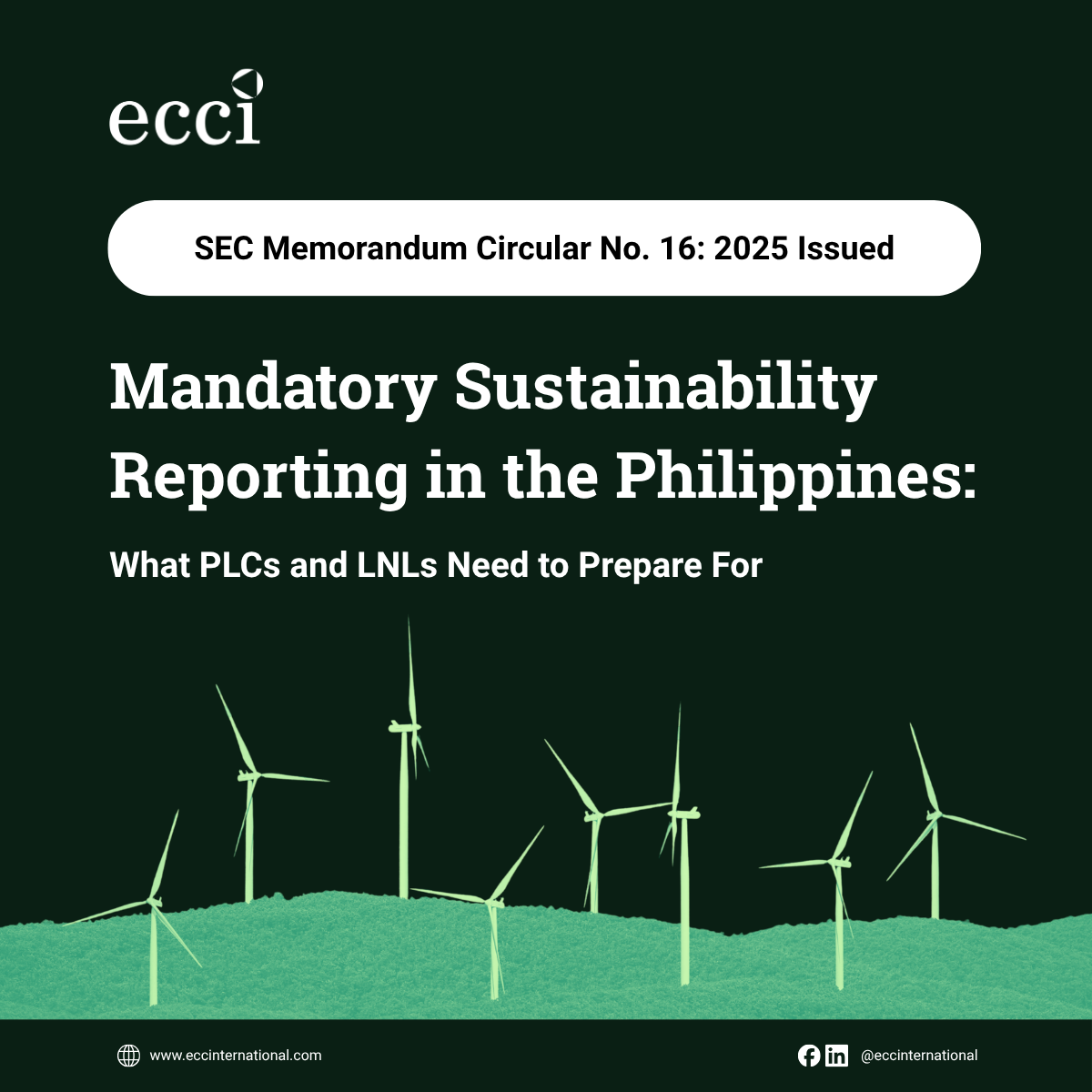
Just two months after releasing its initial exposure draft, the Securities and Exchange Commission (SEC) issued a revised Memorandum Circular on October 24, 2025 seeking public feedback on the adoption of Philippine Financial Reporting Standards (PFRS) S1 and S2 for sustainability disclosures.
Public comments are open until October 30, 2025 via https://tinyurl.com/Revised-SR-Guidelines. The final circular is expected to be released before the end of 2025, paving the way for mandatory reporting starting FY 2026.
This second exposure draft moves the Philippines closer to mandatory, ISSB-aligned sustainability reporting for Publicly-Listed Companies (PLCs) and Large Non-Listed Entities (LNLs).
Missed the first draft? Read our earlier coverage: SEC Issues Draft Circular on Sustainability Reporting: What PLCs and LNLs Need to Know
In Summary: What’s New in the October 2025 Circular
| Update Area | What Changed | Impact for Companies |
| Public Consultation | The SEC opened a second round of public comments until October 30, 2025. | Opportunity for stakeholders to provide feedback before final release. |
| Adoption Timeline | Confirms tiered implementation (FY 2026–2028) for PLCs and LNLs. Confirms that companies will need to submit sustainability reports on an ongoing basis once classified under a tier. | Companies should begin transition planning and system alignment. (Full matrix in Part 1). |
| Inclusion of PDEx-Listed Firms | Expands coverage to include companies whose debt securities are listed solely on the Philippine Dealing & Exchange Corp. (PDEx), even if not equity-listed in the PSE. | PDEx-listed firms are now subject to mandatory sustainability reporting starting FY 2028 (reporting in 2029). |
| Clarification of LNL Criteria | Refines how LNLs are determined — setting FY27 revenue as basis, requiring annual re-evaluation for those that fall below the ₱15B threshold, and specifying that foreign-currency revenues must be translated using the closing exchange rate at the measurement date. | Ensures consistent classification of large entities and accurate evaluation for multinational firms. |
| External Assurance | Requires external limited assurance on Scope 1 & 2 GHG emissions two years after adoption for each Tier. Assurance may be performed by CPAs or qualified non-accountants in accordance with ISSA 5000, the global sustainability assurance standard, with the requirement expected to progress to reasonable assurance over time. Confirms that requirements will progress towards reasonable assurance. No specific timelines have been provided yet. | Firms should start preparing data systems and documentation for third-party verification and long-term assurance readiness. |
| Transition Reliefs | Climate-first reporting, 9-month filing window, and Scope 3 exclusion from mandatory reporting confirmed as final provisions. | Provides short-term flexibility, but signals eventual move toward full ESG scope. |
| Certificate of Exemption | Introduces Annex A, allowing LNL subsidiaries to file an exemption if their parent company already publishes a sustainability report under an equivalent international framework in its home jurisdiction (e.g., ESRS, IFRS Sustainability Standards). | Avoids double-reporting for subsidiaries of multinational groups. Requires signed certificate with supporting documents. |
| Compliance and Penalties | Updates penalty references from SEC MC No. 4, s.2019 to SEC MC No. 6, s.2005 (Consolidated Scale of Fines) and SEC Resolution No. 581, s.2021. The circular also explicitly covers both non-attachment and non-compliance with PFRS S1/S2 requirements. | Penalty treatment remains the same—offense count resets under this circular (first offense)—but the scope is now clearer and applies to both PLCs and LNLs. |
| Repeal of MC No. 4 (2019) | Voluntary 2019 guidelines to be officially repealed upon finalization. Companies may only continue using MC No. 4 (2019) guidelines until the start of mandatory PFRS S1 & S2 adoption based on their tier. | Shifts the reporting regime from voluntary to mandatory. |
| Board Accountability | Sustainability Reports must be approved by the Board of Directors prior to submission. | Strengthens ESG governance and oversight within organizations. |
A Step Closer to Mandatory Sustainability Disclosure
The revised draft integrates feedback from the first consultation held in July 2025 and reinforces the SEC’s goal of aligning the Philippines’ sustainability reporting framework with the ISSB’s IFRS S1 and S2 standards.
Under the confirmed schedule, Tier 1 PLCs (market cap > ₱50B) will begin adopting PFRS S1 and S2 for FY 2026, followed by Tier 2 PLCs (market cap ₱3B–₱50B) in FY 2027, and Tier 3 firms (PLCs with market cap ≤₱3B or LNLs > ₱15B revenue) in FY 2028.
The October draft also expands Tier 3 coverage to include companies whose debt securities are listed solely on the Philippine Dealing & Exchange Corp. (PDEx)—even if they are not equity-listed in the PSE. This means that if a company’s bonds are publicly traded through PDEx, it must also prepare a sustainability report under PFRS S1 and S2, starting FY 2028 (reporting in 2029).
The SEC likewise refined the criteria for determining Large Non-Listed Entities (LNLs): companies with >₱15B annual revenue are required to prepare a sustainability report starting FY2028. Companies that fall below the ₱15 billion revenue threshold will continue to be re-evaluated annually, while those reporting revenues in foreign currencies must translate them using the closing exchange rate at the measurement date. These refinements ensure consistency and comparability in defining large entities across reporting years.
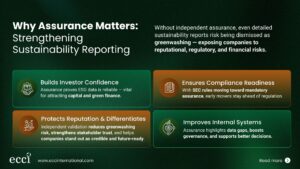
The circular further clarifies external assurance, requiring independent verification of GHG data two years after initial reporting. Assurance engagements may be conducted by CPAs or qualified non-accountants under the International Standard on Sustainability Assurance (ISSA) 5000, the IAASB’s newly issued global benchmark expected to evolve from limited to reasonable assurance over time.
Transition, Exemptions, and Governance
The SEC confirms earlier transition reliefs—such as climate-first reporting and delayed submission—as finalized measures to ease implementation.
It also clarifies that Large Non-Listed Entities (LNLs) may file a Certificate of Exemption (Annex A) if their parent company already publishes a sustainability report under an equivalent framework in its home jurisdiction. This simplifies compliance for subsidiaries included in parent-level disclosures.
Finally, the circular reiterates the need for board-level approval of sustainability reports, strengthening corporate accountability and ESG oversight.
Preparing for the Transition
With the SEC moving toward full adoption, companies are encouraged to:
- Conduct readiness assessments against PFRS S1/S2 requirements;
- Build ESG data systems for GHG and non-financial metrics;
- Train governance teams on sustainability oversight; and
- Engage assurance partners early for Scope 1 & 2 data verification.
The SEC’s October circular marks a decisive shift from voluntary to mandatory, globally aligned sustainability reporting—setting a clear path for Philippine organizations to strengthen ESG transparency, data credibility, and governance integrity ahead of FY 2026.
Partner with ECCI for PFRS S1 & S2 Readiness
ECCI helps organizations prepare credible, audit-ready sustainability disclosures under PFRS S1 and S2.
We support companies to map readiness, develop or validate GHG inventories, build ESG governance and reporting frameworks, and prepare for external assurance under ISSA 5000.
With over 25 years of consulting experience, ECCI enables businesses to move beyond compliance toward sustainable growth and resilience.