Would your business survive a major data breach tomorrow?
Cybersecurity is often treated as a back-office function. But in today’s digital economy, where data, intellectual property, and digital systems account for the majority of corporate value, a single cyber incident can undo years of ESG progress. From crippling operations to eroding trust, cybersecurity has become one of the most overlooked yet decisive tests of ESG maturity.
According to the World Economic Forum’s 2025 Global Cybersecurity Outlook, 72% of cyber leaders see risks rising, with ransomware, intellectual property theft, and social engineering among the top concerns. Yet while climate and social issues dominate ESG discussions, cybersecurity — which underpins governance, trust, and data integrity — is still too often sidelined.
The Overlap That Matters: Cybersecurity in ESG
Cybersecurity clearly sits under Governance, but its reach is broader:
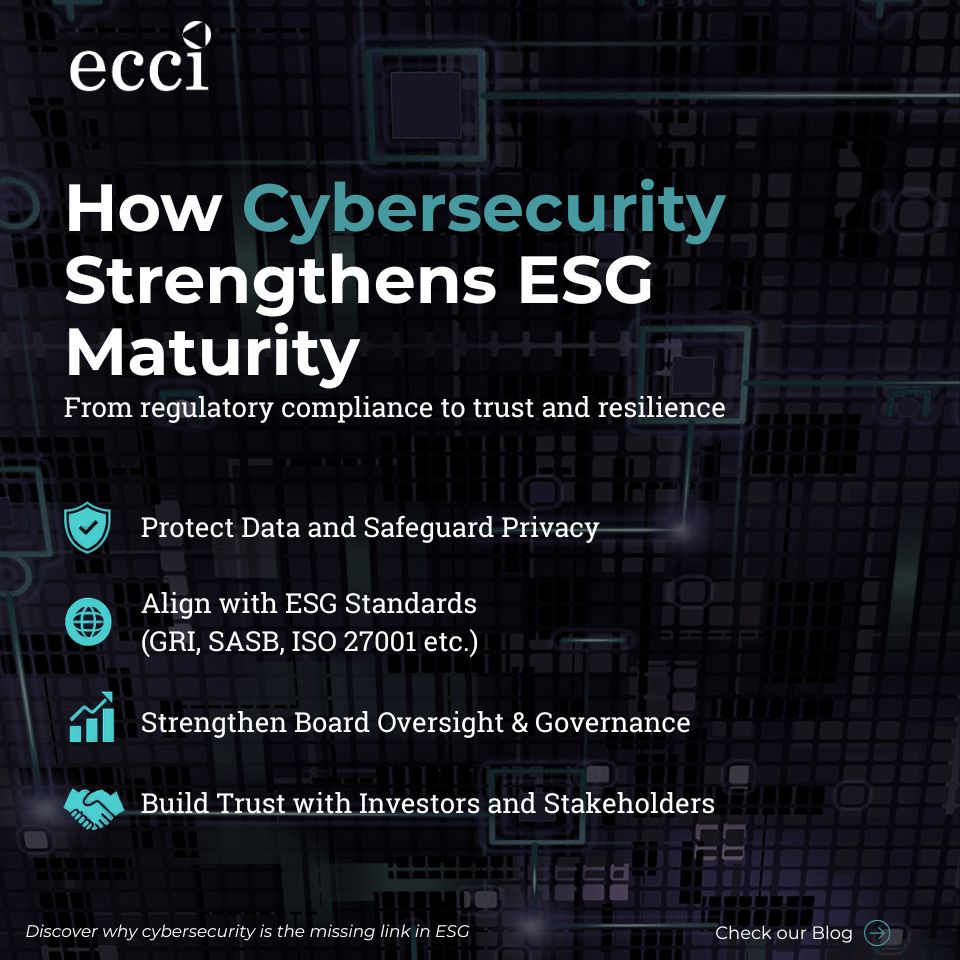
- Governance: Boards are expected to oversee cyber risk, integrate it into enterprise risk management, and disclose incidents transparently. Regulations such as GDPR, NIS2, and the Philippines’ Data Privacy Act make this oversight non-negotiable.
- Social: Protecting employee and customer data is fundamental to trust. Breaches spill into identity theft, financial fraud, and disruption of healthcare or essential services — making data privacy a social responsibility.
- Environmental: Cybersecurity safeguard the integrity of ESG Data from emissions reporting and climate metrics to supply chain and governance records. Without strong data protection, ESG efforts risk compromised reports, regulatory non-compliance and disrupted sustainability initiatives.
In short: ESG maturity without cyber resilience is incomplete.
How Leading Companies Are Responding
Around the world, forward-looking organizations are closing the ESG–cyber gap by:
Disclosure: Reporting cyber risks in ESG filings, including breach metrics, third-party exposures, and response times.
Standards & Compliance: Aligning with ISO 27001, NIST CSF, GDPR, and frameworks like SASB and GRI, both of which now call for cyber risk disclosures.
Governance: Elevating CISOs to board visibility, creating cyber risk committees, and integrating cyber into enterprise risk management.
Technology & Resilience: Deploying AI-driven detection, Zero-Trust architectures, and supply chain monitoring.
Even in the Philippines, companies notifying the National Privacy Commission after breaches and publishing clearer privacy policies demonstrate that cybersecurity is already a matter of regulatory accountability and public trust.
Cybersecurity’s Role in Each ESG Pillar
| ESG Pillar | Cybersecurity Connection | Risk if Ignored |
|---|---|---|
| Environmental | Implements encryption and access controls to secure emissions and climate data, uses tamper-detection tools to maintain integrity of ESG Reports. | Attackers can alter emissions data to falsify compliance, and cause reporting inaccuracies – resulting in regulatory penalties, wasted efforts and loss of stakeholder trust. |
| Social | Safeguards data privacy, protects customers and employees, addresses AI/data ethics, supports digital safety and freedom of expression | Loss of trust, lawsuits, fraud, regulatory probes, reputational loss |
| Governance | Ensures board oversight, integrates cyber into ERM, aligns reporting with ESG standards (SASB, GRI), strengthens transparency | Regulatory fines, governance scandals, weak disclosures, unchecked vulnerabilities |
Ignoring cyber risks leaves ESG maturity — and reputation — dangerously exposed.
Why Cybersecurity in ESG Matters More Than Ever
Organizations can no longer treat cyber and ESG as separate agendas. Both are about managing risks and opportunities — building resilience, enabling better solutions, and strengthening societal trust.
Markets and ESG rating providers are starting to recognize this link, pushing for greater transparency in how companies disclose cyber risks. Protecting infrastructure, data, and digital ecosystems now requires robust cybersecurity and privacy controls, and many companies are already seeing ESG performance benefits from doing so.
By embedding cybersecurity into ESG, businesses safeguard operations, protect stakeholders, and preserve reputation — while advancing environmental and social goals.
How ECCI Helps Companies Strengthen Cybersecurity in ESG
Cyber threats can quickly escalate from IT issues to enterprise-wide crises. At ECC International (ECCI), we help organizations get ahead of these risks by embedding cybersecurity into their ESG strategy — from risk assessments and ISO 27001 adoption to leadership oversight and policy integration. We strengthen preparedness through employee training, vendor risk management, and tested incident response plans, while enabling transparent cyber reporting in ESG disclosures.
With continuous monitoring and improvement, we help companies safeguard reputation, ensure continuity, and protect long-term value.
In a digital-first economy, resilience isn’t just about technology — it’s about governance, accountability, and trust. That’s where ECCI comes in.
👉 Learn more here.