For most SMEs in the Philippines, PFRS S2 reads like someone else’s problem. MSMEs account for 99.59% of all business establishments in the country, and under SEC Memorandum Circular No. 16, Series of 2025, none of them are directly required to file sustainability reports.
But legal exemption and economic exemption are very different things.
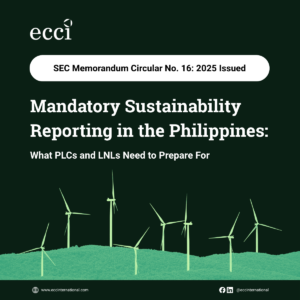
On December 22, 2025, the SEC issued PFRS S1 (General Sustainability Disclosures) and PFRS S2 (Climate-related Disclosures) under SEC Memorandum Circular No. 16, Series of 2025, replacing the comply-or-explain framework under MC 4, s. 2019 with binding, enforceable obligations — with phased rollouts beginning in FY 2026 for PLCs above PHP 50 billion in market capitalisation, FY 2027 for those between PHP 3 billion and PHP 50 billion, and FY 2028 for smaller PLCs and large non-listed entities with revenue above PHP 15 billion. Full details can be read here.
Why PFRS S2 Reaches Philippine SMEs
PFRS S2 requires covered companies to disclose emissions across three scopes. Scopes 1 and 2 cover their own operations. Scope 3 covers the entire value chain, including every supplier, contractor, and distributor they work with.
The SEC has granted a two-year Scope 3 deferral. However, this is a preparation window, – not a pause. Conglomerates may use industry averages for Scope 3 reporting under PFRS S2, provided their use is disclosed. However, averages offer limited visibility into supplier-level reductions and progress against engagement targets, driving large buyers toward primary supplier data.
That means they need your fuel records, electricity bills, and waste data, now.
The numbers show this is already underway. Major Philippine conglomerates are reporting that the overwhelming majority of their carbon footprint sits within Scope 3, with some cases exceeding 90% of their total emissions. Others are actively expanding their data boundaries year over year to tighten supplier baselines and identify reduction opportunities.
If you supply goods, services, or logistics to a large Philippine enterprise, an ESG data request is coming — if it hasn’t arrived already.
Exporters face a second front. The EU’s Carbon Border Adjustment Mechanism (CBAM) begins imposing carbon taxes on imports in 2026. Without emissions data, they lose price competitiveness in European markets.
How ECCI Helps
ECCI’s Corporate Sustainability and Governance service line is built for exactly this transition. For conglomerates, ECCI designs Scope 3 value chain mapping programs, supplier enablement training, and pre-assurance readiness reviews aligned to ISSA 5000. For SMEs, ECCI delivers GHG inventories, board-level governance frameworks, and double materiality assessments — all calibrated to the Philippine regulatory environment.
A verified carbon footprint is no longer an administrative task: it is a sales pitch, a procurement credential, and a financing advantage, all at once.
Start preparing today. Visit this link to learn more.